Your AQA vocabulary,
planned day by day.
Sapling turns the current AQA GCSE Spanish vocabulary list into short daily recall, listening, dictation and speaking sessions — organised by tier and paced around your exam.
Free to download. iPhone, iOS 17 or later. No account, no login — your progress stays on your device.
Built for the current AQA GCSE,
not a generic language course.
Sapling specialises in the vocabulary retrieval that supports listening, speaking, reading and writing. Use it alongside lessons, grammar work and past papers.
Your whole tier, nothing spare
1,729 Higher and 1,258 Foundation practice entries across AQA's nine topics. Higher includes Foundation; if your tier is undecided, start with vocabulary shared by both.
Timed to your exam date
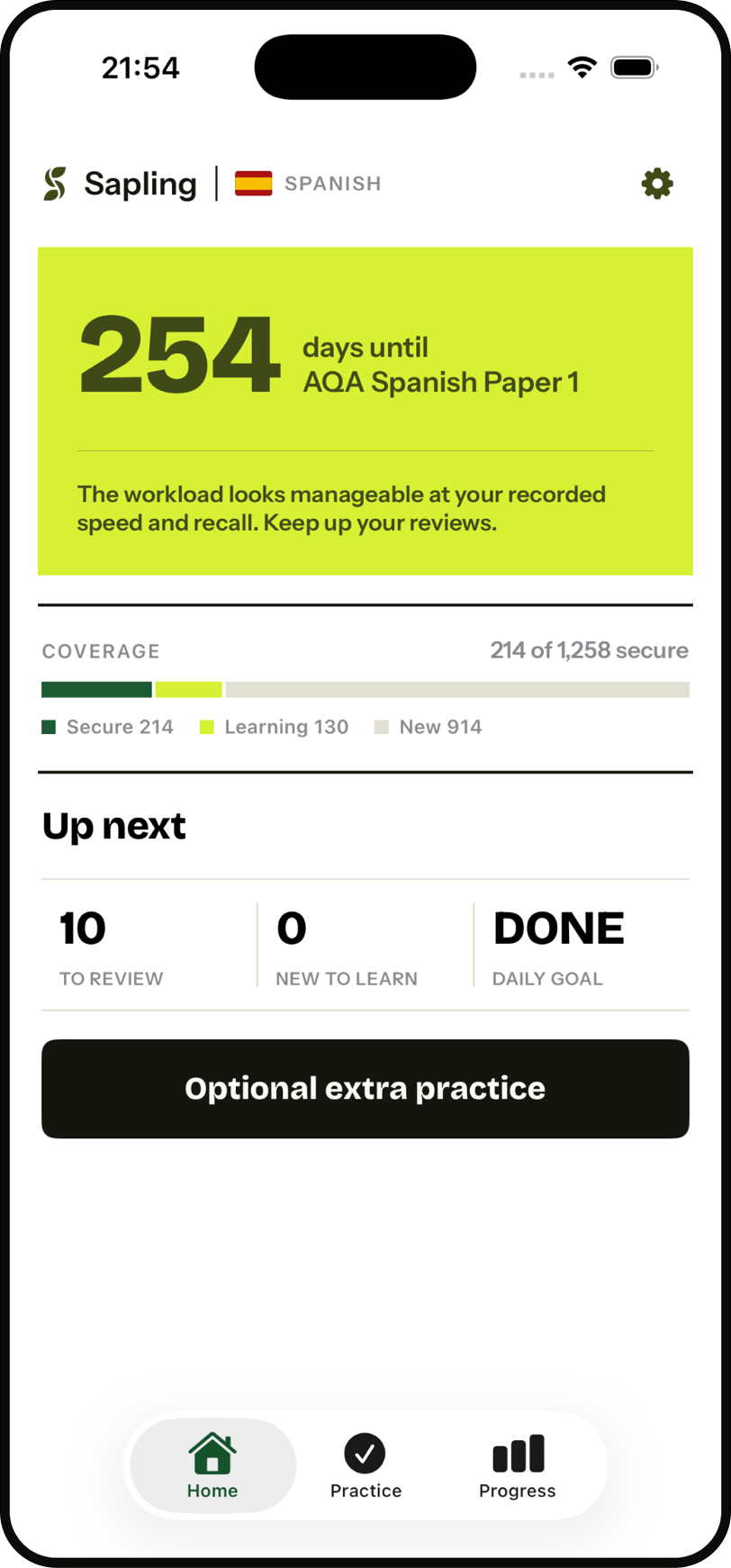
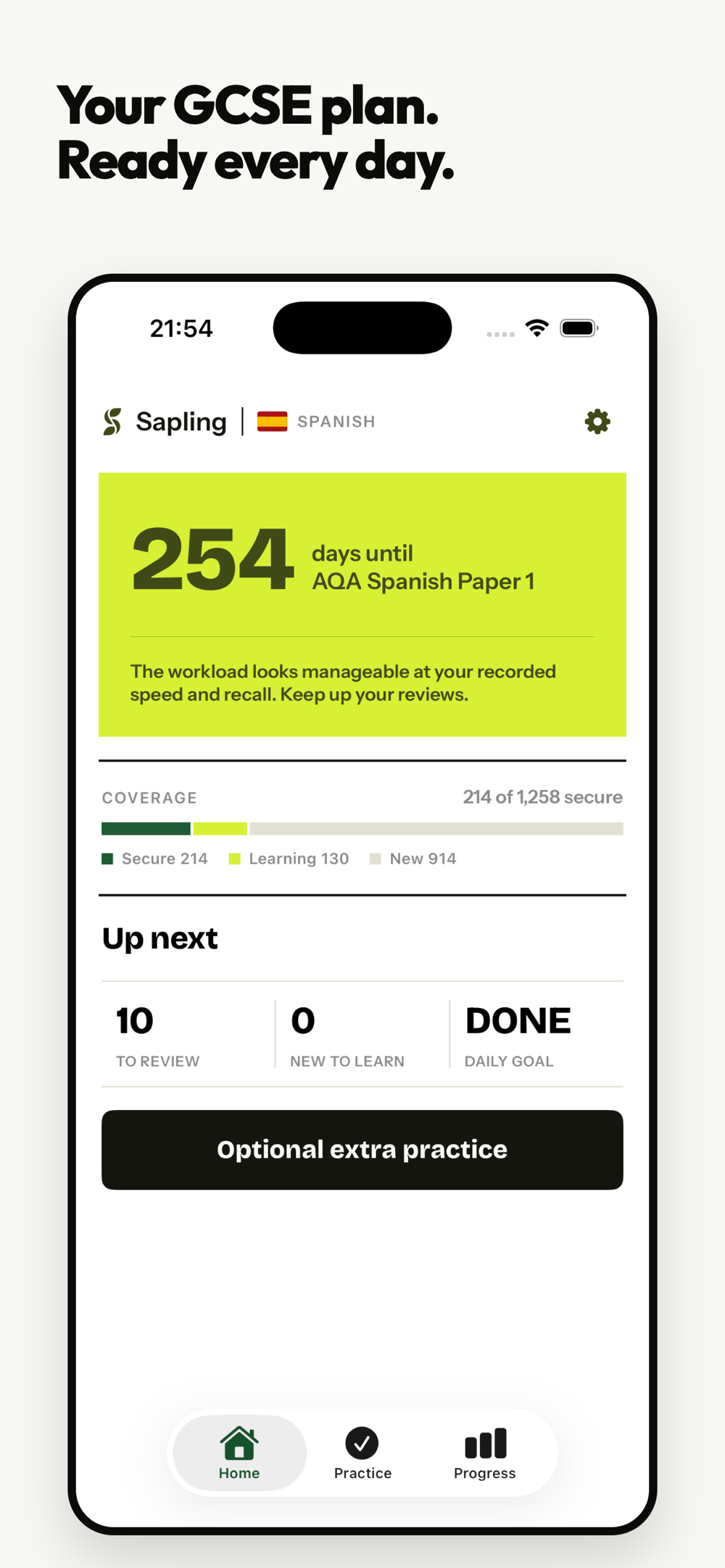
Set your paper date and the minutes a day you can manage. Sapling works out how many new words a day gets you there — and says so plainly.
More than flashcards
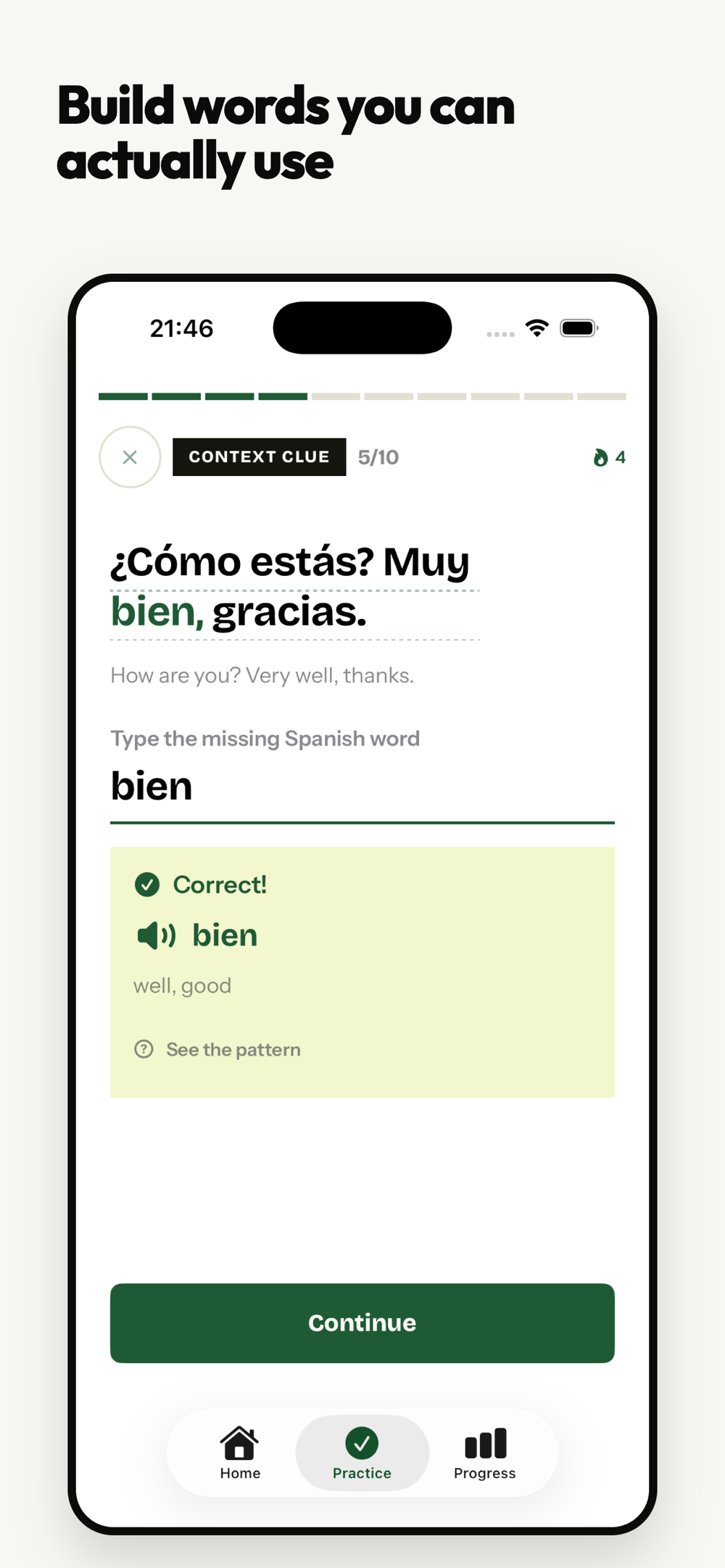
Type the missing word from context, listen, take dictation, and recall Spanish in writing or aloud. Recognising a word isn't the same as producing it.
Speaking and listening too
Dictation asks you to type a sentence you hear. Speaking recall uses speech recognition to check a Spanish word produced from memory; Sapling does not record or store your voice.
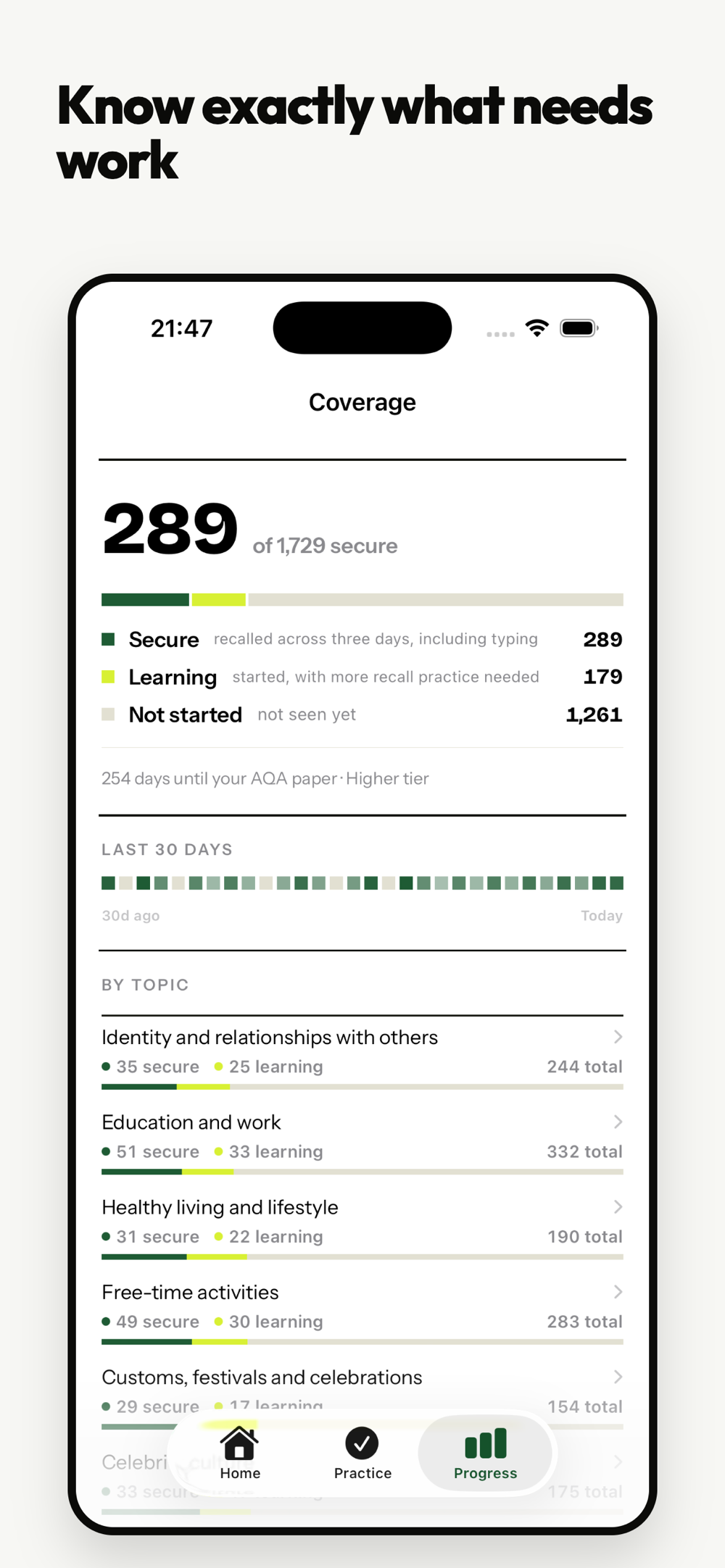
Secure, learning, not started
Progress by word and by topic — how much is genuinely secure, not hours logged or a streak. Secure means recalled across three days, including typing.
No account, no faff
No sign-up, no email, no password. Open it and start. Your progress is stored privately on your iPhone.
Four screens you'll
actually use.
Three taps, then just
show up daily.
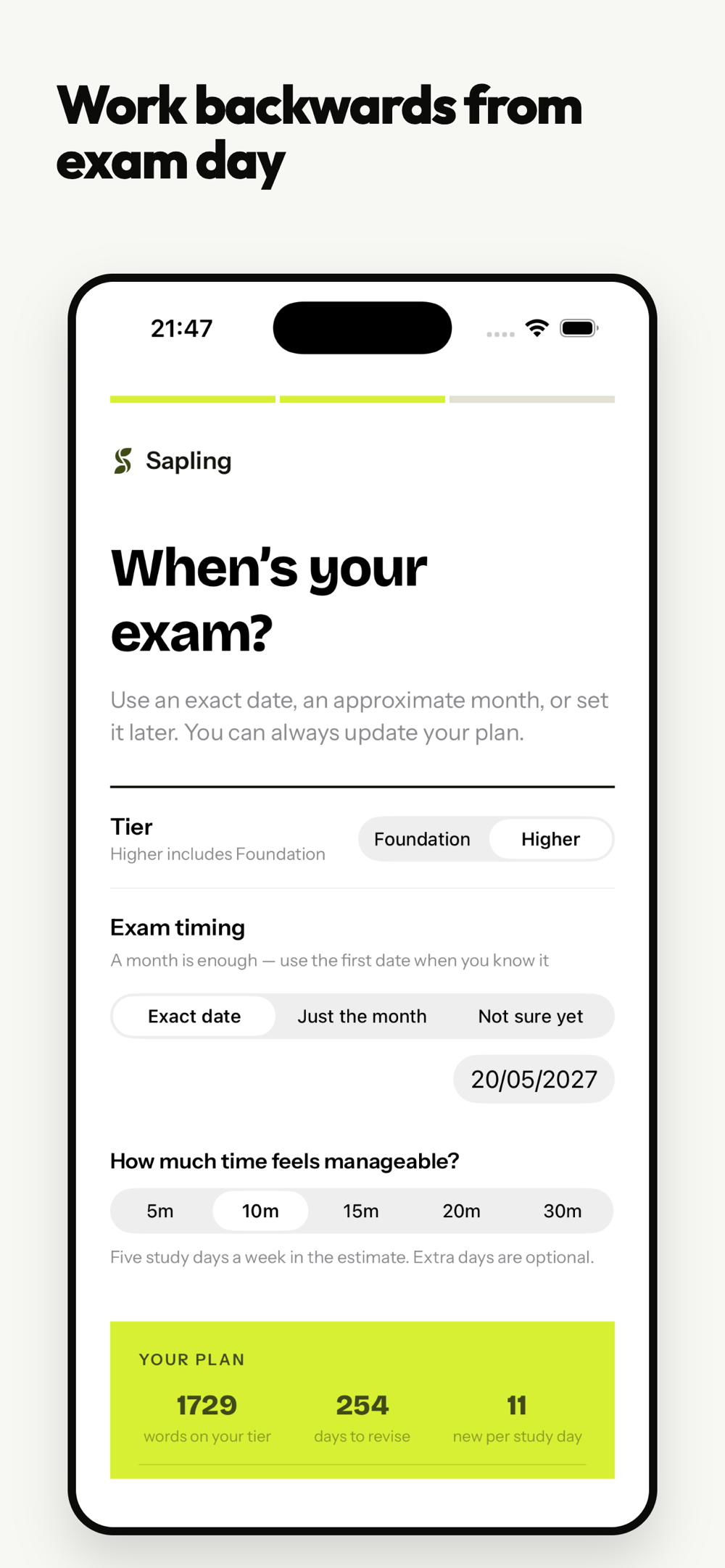
Set the exam
Choose Foundation, Higher or Not sure yet; add an exact date, a month or no deadline; then set the minutes a day you can manage.
Get today's list
Reviews first, then new words, paced to hit your date across five study days a week. Each session has an end you can see.
Watch coverage climb
Words move from not started to learning to secure, and anything shaky comes back on its own before the exam.
How to actually make GCSE
Spanish vocab stick.
-
Little and often beats cramming
Ten focused minutes a day moves words into long-term memory. One panicked three-hour session the night before doesn't.
-
Test recall, not recognition
Spotting a word in a list is easy. Producing it from the English — typing it, saying it — is what the paper asks for. More in our guide to revising GCSE Spanish vocabulary.
-
Revise by topic and tier
Grouping vocabulary by AQA topic makes it easy to reinforce what you are learning in class — our free GCSE Spanish vocabulary lists are laid out exactly that way.
-
Work backwards from the date
Knowing how many days are left — and pacing new words against it — is what stops revision drifting until it's too late.
Free to start. Focused
practice for a full year.
Download and try it for nothing. Full access is an optional subscription — both options unlock the same thing: your whole tier, every exercise type, planning and progress.
- Your full tier, Foundation or Higher
- Exam-date planning and daily workload
- Covers the whole GCSE year
- Your full tier, Foundation or Higher
- Exam-date planning and daily workload
- For joining closer to the paper
Prices shown for the UK App Store. Payment is charged to your Apple Account; subscriptions renew automatically unless cancelled at least 24 hours before the end of the period. Manage or cancel any time in your App Store settings.
Before you start.
Which exam board does Sapling cover?
Sapling is built around the current AQA GCSE Spanish vocabulary list, organised by topic and tier, covering both Foundation and Higher papers.
How much AQA GCSE Spanish vocabulary does Sapling cover?
Sapling organises the prescribed list into 1,729 Higher and 1,258 Foundation practice entries across AQA's nine topics. AQA describes the specification as 1,200 Foundation lexical items and 500 additional Higher items, plus specified phrases and cultural items.
What's the best way to revise GCSE Spanish vocabulary?
Short, regular sessions that mix recognition and recall. Seeing a word, typing it from context, hearing it and saying it back all build different connections — Sapling schedules a mix of these every day, so vocabulary moves from "I've seen that" to something you can produce under exam conditions.
Is Sapling free?
It's free to download and try. Full access is an optional subscription: a GCSE Year Pass at £19.99 a year, or Finish-line access at £6.99 a month if you're joining closer to the exam.
Do I need an account?
No. There's no sign-up, no email and no password. Your learning progress is stored privately on your iPhone.
Can it work around my exam date?
Yes. Set your tier, paper date and daily time budget, and Sapling tells you how many new words a day gets you there, adjusting as you go. If you don't know your tier or exact date yet, you can start with shared vocabulary and add those details later.
Is Sapling suitable before Year 10?
Yes. A learner who does not know their eventual tier or exam date can start with the vocabulary shared by both tiers and build a short, regular revision habit before the GCSE course begins.
Does Sapling replace lessons or past papers?
No. Sapling focuses on learning and retaining prescribed vocabulary. Use it alongside classroom teaching, grammar and extended-writing practice, speaking preparation and official sample or past papers.
Is Sapling made by AQA?
No. Sapling is an independent revision tool built around the published AQA specification. It is not affiliated with or endorsed by AQA.
Your GCSE vocabulary,
planned.
Try your first lesson free. Add your tier and exam timing when you know them, then let Sapling plan the next short session.
Download on theApp Store